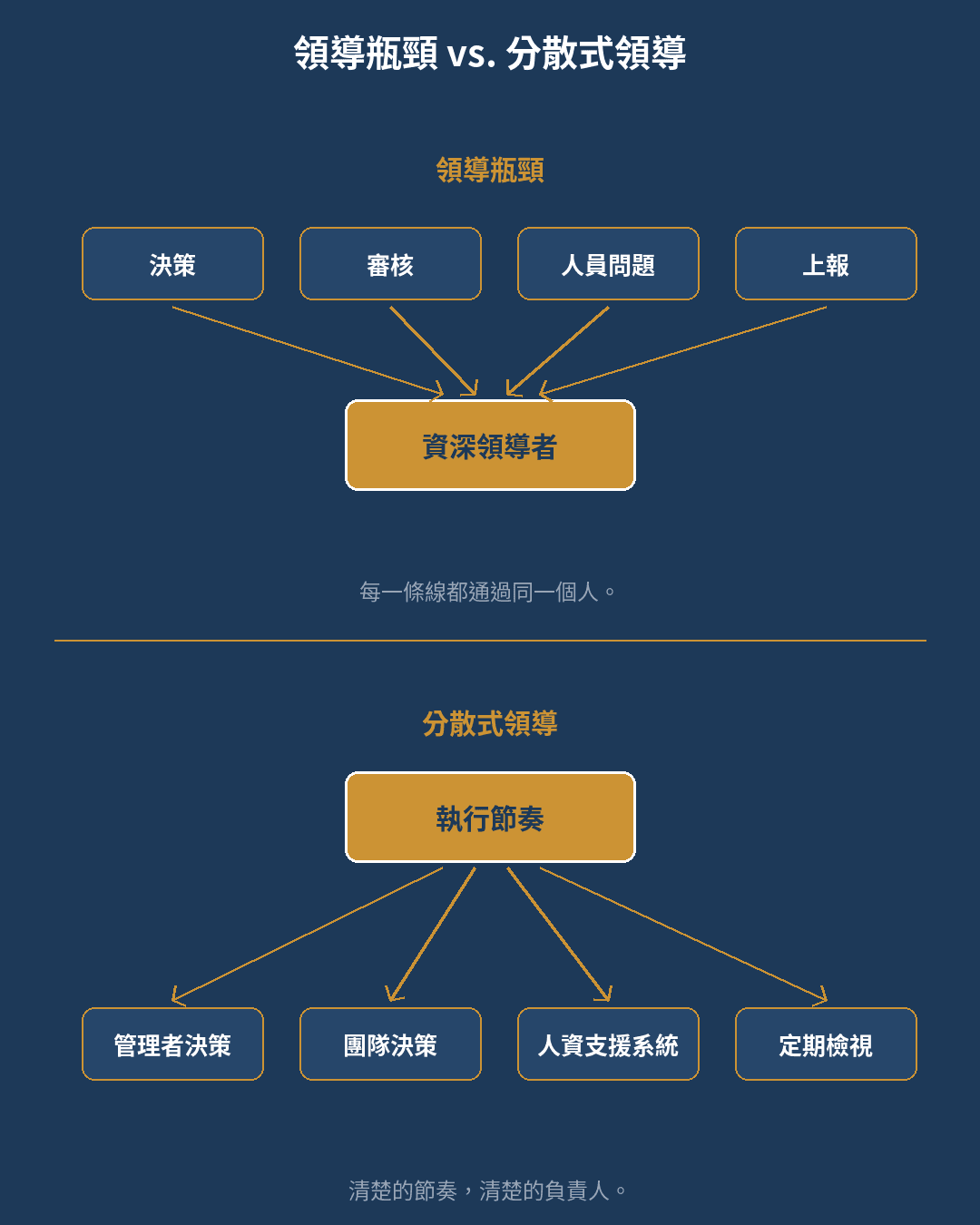
Leadership bottlenecks appear when decisions, accountability, and people issues depend too heavily on one senior leader. The team may look busy, but execution slows because ownership is not distributed.
Andy Chang , Founder, Top Leadership Institute July 20, 2026
A leadership bottleneck happens when decisions, approvals, corrections, and people issues depend too heavily on one senior leader. It slows execution because managers and teams wait for direction instead of owning the next step.
### Why Leadership Bottlenecks Slow Company Execution
If every difficult decision, correction, approval, or people issue comes back to the same senior leader, the company may look active, but it is not moving at full speed. It is waiting.
This is the pattern behind many leadership bottlenecks.
A leadership bottleneck is not simply a busy founder, overloaded general manager, or hardworking executive. It is a system pattern where too much ownership depends on one person. Decisions wait for that person. Managers wait for permission. People issues move upward instead of being handled close to the work. HR becomes the place where unresolved culture problems land.
The company may still have meetings, projects, dashboards, and deadlines. People may be working hard. But execution slows because the organization has not developed enough distributed leadership capacity.
## What Is A Leadership Bottleneck?
A leadership bottleneck happens when decisions, accountability, and people issues depend too heavily on one senior leader.
The bottleneck may show up as:
- routine decisions waiting for founder approval
- managers escalating difficult conversations instead of handling them
- teams asking for direction even when priorities were already discussed
- HR carrying culture issues that managers should help own
- projects moving forward only when the senior leader personally follows up
- unclear owners after meetings
- repeated delays because people are waiting for final confirmation
The senior leader is usually not the problem. In many companies, the senior leader became the bottleneck because they were the most capable, most committed, or most trusted person in the room. Early in the business, that may have helped the company survive.
But what helps a company survive one stage can limit the next stage.
As the organization grows, the leader's personal capacity becomes a ceiling. If every important action depends on one person's attention, judgment, or approval, the company cannot move faster than that person's available time.
## Why Busy Teams Can Still Move Slowly
One reason leadership bottlenecks are hard to see is that they do not always look like inactivity.
The calendar is full. People are answering messages. Managers attend meetings. HR is busy. The founder or general manager is constantly solving problems.
But busyness is not the same as execution.
Execution requires clear priorities, clear owners, timely decisions, honest feedback, and follow-through. When those pieces depend too heavily on one senior leader, the team may stay busy while real progress slows.
The most common pattern looks like this:
unclear owner -> delayed decision -> escalation to senior leader -> temporary fix -> same pattern repeats
Over time, the organization learns that the fastest way to get certainty is to wait for the senior leader. Managers become cautious. Team members avoid ownership. HR receives the people problems. The leader feels trapped because stepping back seems risky, but staying involved in everything keeps the pattern alive.
## The Bottleneck Is Usually An Ownership Problem
Many leaders try to solve bottlenecks by working longer hours, joining more meetings, or giving more detailed instructions. That may help for a week, but it does not solve the deeper issue.
The deeper issue is ownership.
When managers are unsure what they own, they escalate. When teams are unsure who decides, they wait. When feedback feels uncomfortable, people avoid it. When priorities are not reviewed in a steady rhythm, urgency gets replaced by reaction.
This is why leadership bottlenecks are connected to trust and accountability. A company cannot distribute ownership if leaders do not trust managers to make good decisions. Managers will not carry ownership if they believe every mistake will be punished or every decision will be second-guessed.
The goal is not to remove the senior leader from important decisions. The goal is to define which decisions should stay with senior leadership, which decisions should move to managers, and what rhythm keeps everyone aligned.
## Why HR Often Feels The Pressure
Leadership bottlenecks often create pressure for HR.
When managers avoid difficult conversations, HR becomes the place where performance, behavior, and culture issues go to be solved. This can make HR look like the company police, even when HR should be helping design the people system.
At Top Leadership Institute, we use a different framing:
HR is the culture architect.
Managers are culture carriers.
HR can design standards, systems, training, and support. But managers carry culture through daily conversations, expectations, feedback, and follow-through.
If managers do not carry those responsibilities, the company creates another bottleneck. Instead of every decision flowing to the founder, every people issue flows to HR.
The result is the same: ownership is not distributed.
## The First Shift: From Hero Leader To Leadership System
Many founders and senior leaders became successful because they were willing to step in, solve problems, and carry responsibility. That strength should be respected.
But the next stage requires a different question:
What should the leadership system carry, so one person does not have to carry everything?
This does not mean lowering standards. It means making standards clearer.
A healthier leadership system defines:
- which decisions belong to which level
- which managers own which people conversations
- what issues should be escalated and what issues should be handled locally
- how priorities are reviewed
- how follow-up is tracked
- how feedback is given
- how trust is repaired when commitments are missed
Without this system, the leader remains the default answer.
## What To Diagnose First
If you suspect your company has a leadership bottleneck, do not start by asking who is at fault. Start by diagnosing where ownership breaks down.
Useful diagnostic questions include:
1. Which decisions wait too long because people are looking for approval?
2. Which issues repeatedly escalate to the same senior leader?
3. Which managers avoid feedback or performance conversations?
4. Which meetings end without a clear owner and next action?
5. Which culture issues are being carried by HR instead of managers?
6. Which priorities are reviewed consistently, and which disappear after launch?
7. Where does the senior leader feel unable to step away?
These questions reveal whether the bottleneck is about decision rights, manager confidence, trust, accountability, or execution cadence.
Most companies need more than one fix. They need clearer ownership and a steadier rhythm.
## How To Reduce A Leadership Bottleneck
Reducing a bottleneck does not happen by telling people to "take more ownership." Ownership has to be designed, practiced, and reinforced.
Start with five practical moves.
### 1. Name The Decisions That Should Not Require Senior Approval
Make decision rights visible. If managers do not know what they can decide, they will keep asking.
Define which decisions are:
- senior-leader decisions
- manager-owned decisions
- team-level decisions
- decisions that require consultation but not approval
This gives managers room to act without guessing.
### 2. Create A Manager Conversation Standard
Managers need a clear expectation for handling feedback, accountability, and team behavior. If every difficult conversation moves to HR or the founder, managers never build the muscle.
The standard should answer:
- What conversations must managers handle directly?
- When should HR support the manager?
- When should an issue be escalated?
- What documentation is needed?
This helps HR support the system instead of becoming the only owner of culture problems.
### 3. Install A Weekly Execution Cadence
A weekly cadence reduces the need for constant chasing.
Each week, review:
- top priorities
- named owners
- progress since last review
- blocked decisions
- commitments for the next week
- follow-up from missed commitments
The goal is not more meetings. The goal is fewer surprises.
### 4. Build Trust Through Small Delegated Decisions
Do not move from full control to full delegation overnight. Start with smaller decision areas where managers can practice ownership and receive coaching.
Trust grows when expectations are clear, decisions are reviewed, and learning is allowed.
### 5. Track The Repeated Escalations
Every repeated escalation is data.
If the same type of issue keeps coming back to the senior leader, ask:
- Is the owner unclear?
- Is the standard unclear?
- Is the manager untrained?
- Is trust too low?
- Is the decision too risky to delegate?
The pattern tells you what the leadership system needs next.
## The Real Goal Is Not Less Leadership
Reducing a leadership bottleneck does not mean the founder, owner, or general manager leads less.
It means leadership becomes more effective.
The senior leader moves from being the only decision point to designing the system that helps others decide well. Managers move from waiting to carrying ownership. HR moves from receiving every people problem to shaping the culture system. Teams move from activity to clearer execution.
That is the shift from heroic leadership to scalable leadership.
If your company is busy but execution still feels slow, the issue may not be effort. It may be a leadership bottleneck.
Start by diagnosing where decisions, ownership, and people issues are getting stuck. Then build the leadership system that lets more people carry the work well.
Related questions
What is a leadership bottleneck?
A leadership bottleneck is a pattern where decisions, approvals, corrections, and people issues depend too heavily on one senior leader. It slows execution because managers and teams wait for direction instead of owning the next step.
How does a leadership bottleneck slow execution?
It delays decisions, weakens ownership, increases escalations, and causes managers to wait for approval. The team may stay busy, but progress slows because accountability is not distributed clearly.
How can managers reduce leadership bottlenecks?
Managers reduce bottlenecks by owning appropriate decisions, handling direct feedback conversations, clarifying next actions, and following a steady execution cadence. Senior leaders still coach and guide, but managers carry more daily ownership.
Why does HR often feel pressure from leadership bottlenecks?
When managers avoid difficult people conversations, HR becomes the default owner of culture and behavior issues. HR should help design the people system, but managers must carry culture through daily expectations, feedback, and follow-through.
Start a leadership diagnostic
Submit an inquiry to identify where leadership bottlenecks are slowing ownership, trust, and execution in your company.